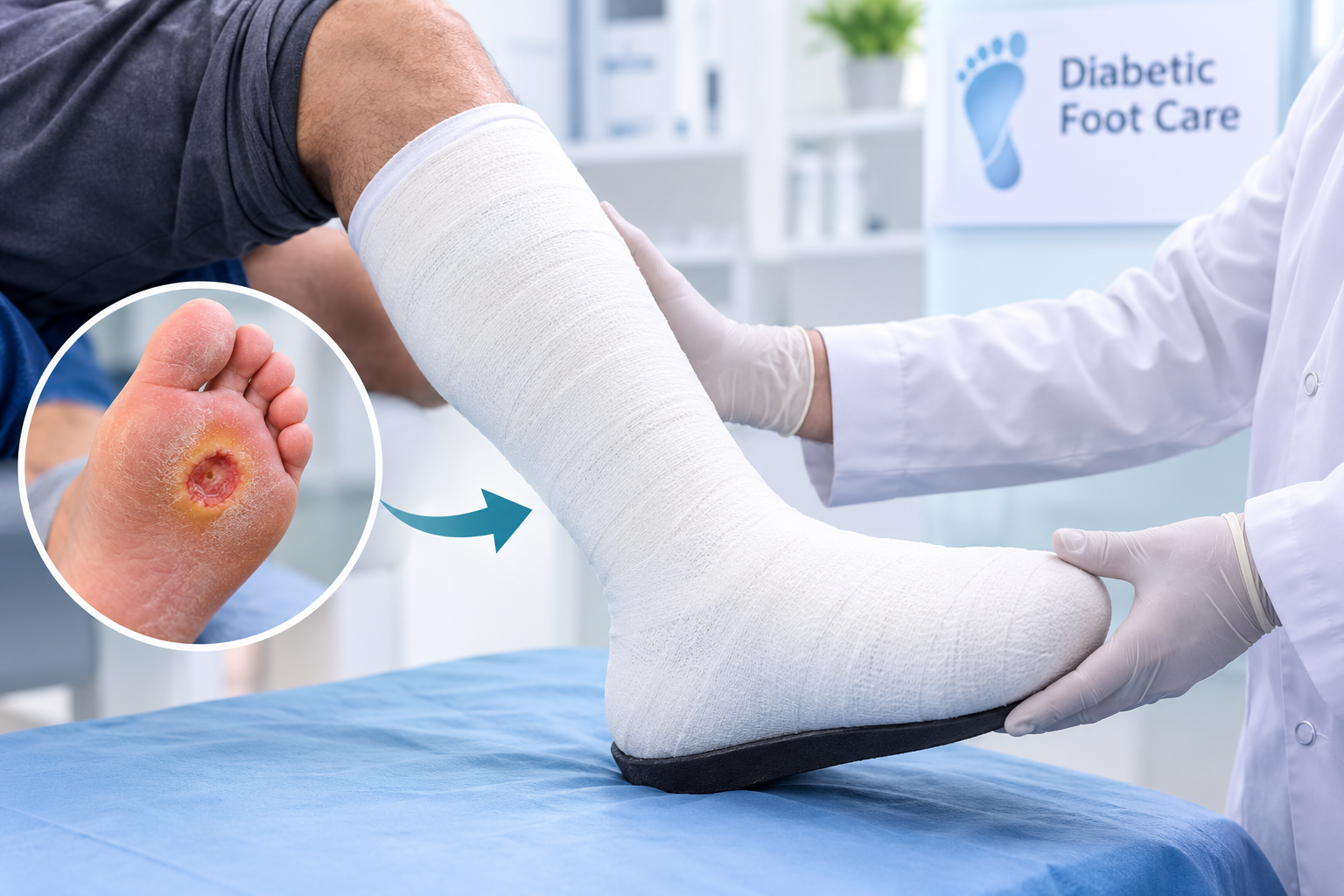
Total contact cast dressing treatment is a specially moulded, non-removable cast that redistributes pressure away from a diabetic foot ulcer, allowing it to heal while you continue to walk. It's widely recognised as the gold-standard offloading device for plantar diabetic foot ulcers, because it removes pressure from the wound more consistently than removable alternatives.
Pressure is one of the biggest reasons plantar diabetic foot ulcers refuse to heal — every step re-injures a wound that never gets the chance to close. Total contact cast dressing treatment addresses this directly by evenly distributing weight across the entire foot and lower leg, taking pressure off the ulcer itself while keeping the patient mobile.
What Is a Total Contact Cast?
A total contact cast (TCC) is a custom-moulded cast, usually made of fibreglass or plaster, that is applied in close, "total" contact with the entire foot and lower leg, extending up to just below the knee. Unlike a standard cast used for a broken bone, a TCC is specifically shaped and padded to spread body weight evenly across the whole foot, taking direct pressure off the ulcer site with every step. It's non-removable, which is central to why it works so well — the patient can't take it off between clinic visits, so offloading is consistent day and night.
Why Offloading Matters So Much for Wound Healing
Repetitive pressure on a wound with each step is one of the single biggest barriers to healing a plantar diabetic foot ulcer, and diabetic neuropathy makes this worse because patients often can't feel the pressure that's damaging the tissue. International diabetic foot guidelines describe offloading mechanical stress as one of the most important interventions for healing these wounds — arguably more important than the dressing applied on top of it. A total contact cast addresses this at the source, rather than only treating the wound surface.
Who Needs Total Contact Cast Treatment?
- A plantar (sole of the foot) diabetic foot ulcer that hasn't been responding to standard dressings alone
- A neuropathic ulcer where reduced sensation means the patient can't reliably protect the area themselves
- An ulcer at high risk of re-injury from ordinary walking or standing
- Cases where good blood flow to the foot has already been confirmed, since offloading works best once circulation is adequate
Not every wound is suitable for a TCC — active infection or significant blood flow problems generally need to be addressed first, which is why a proper diabetic foot assessment always comes before offloading is prescribed.
How Is a Total Contact Cast Applied?
- Wound assessment: The ulcer is examined, cleaned, and any dead tissue debrided before casting.
- Padding: Protective padding is placed over bony areas and the wound to prevent new pressure points.
- Casting: Fibreglass or plaster casting material is carefully moulded to match the exact contours of the foot and lower leg.
- Walking sole attachment: A rigid walking sole is added so the patient can bear weight safely while the cast is worn.
- Scheduled cast changes: The cast is removed and reapplied on a set schedule, typically every one to two weeks, so the wound can be checked and progress monitored.
Total Contact Cast vs Other Offloading Methods
| Offloading Method | Removable? | Effectiveness |
|---|---|---|
| Total Contact Cast (TCC) | No — non-removable | Considered the gold standard; most consistent pressure relief |
| Removable Cast Walker | Yes | Effective only if genuinely worn consistently, which is often the weak point |
| Therapeutic Offloading Footwear | Yes | Better suited to prevention and milder cases than active plantar ulcers |
What Does Research Say About Total Contact Casting?
Evidence consistently supports TCC as the most effective offloading option available. A 2023 systematic review and meta-analysis of 12 controlled trials involving 591 patients found that total contact casts achieved significantly higher ulcer healing rates and shorter healing times compared with removable offloading devices, though TCCs were also associated with a higher rate of device-related complications such as skin irritation (PMC, 2023). International diabetic foot guidelines from the International Working Group on the Diabetic Foot similarly recommend a non-removable knee-high offloading device as first-line treatment for neuropathic plantar forefoot or midfoot ulcers. Interestingly, despite this strong evidence, studies have repeatedly found that TCC remains underused in everyday clinical practice, largely because of the specialised training and clinic time it requires.
What Are the Risks and Limitations of Total Contact Casting?
Because a TCC can't be removed at home, careful application and monitoring matter. Documented risks include skin irritation or new pressure sores if the cast isn't fitted correctly, restricted mobility, and the inconvenience of not being able to inspect the wound between scheduled changes. This is exactly why TCC application requires a clinician specifically trained in the technique, and why regular, scheduled cast changes are non-negotiable rather than optional.
What Does Total Contact Cast Treatment Cost?
Cost depends on how many cast changes your ulcer needs, how it's healing, and whether other therapies — such as advanced dressings or infection management — are being used alongside it. Because treatment length varies so much by wound severity, an accurate cost estimate is only possible after an in-person foot assessment.
Total Contact Cast Treatment at EDFC, Surat
At Elegance Diabetic Foot & Ulcer Clinic (EDFC), total contact cast dressing treatment is offered as part of a coordinated offloading and wound-care pathway, led by Dr. Ashutosh Shah, a plastic and microvascular surgeon with over two decades of experience in limb salvage across Surat, Gujarat and EDFC's growing clinic network. As an expert doctor treating diabetic foot ulcers under one roof, Dr. Shah's team pairs offloading with proper circulation checks and infection control, since a cast alone can't heal a wound that also has poor blood flow or active infection underneath. Explore our full range of footwear and offloading services, including therapeutic offloading footwear for ongoing protection once the ulcer has healed.
Concerned About a Diabetic Foot Ulcer?
A wound that isn't healing deserves prompt assessment rather than trial and error at home. Book a consultation with EDFC in Surat, or send a photo of the wound on WhatsApp for a quick initial assessment.
This article is for general educational purposes only and is not a substitute for an in-person diagnosis. Please consult Dr. Ashutosh Shah or a qualified clinician for advice specific to your condition.
quiz Frequently Asked Questions
This article is general education, not a diagnosis. If you have a diabetic foot wound, please have it assessed in person. Send a photo on WhatsApp or book a consultation.
About the Author

Dr. Ashutosh Shah, Plastic, Reconstructive & Diabetic Foot Surgeon, Elegance Diabetic Foot & Ulcer Clinic, Surat
Dr. Ashutosh Shah is a board certified plastic and reconstructive surgeon with over 22 years of experience and more than 10,000 limbs and feet saved. He founded Elegance Diabetic Foot & Ulcer Clinic, India's first chain of clinics dedicated to foot care, with centres in Surat and OPD partners across South Gujarat. He is known for a limb first approach, safe wound care and ethical, natural results.