Written by Dr. Ashutosh Shah, Plastic & Microvascular Surgeon - Diabetic Foot & Limb Salvage Specialist, Elegance Diabetic Foot & Ulcer Clinic (EDFC). Practising since 2004 (22+ years). Read full bio.
Medically reviewed by Dr. Ashutosh Shah · Published 7 August 2026 · Last reviewed 7 August 2026.
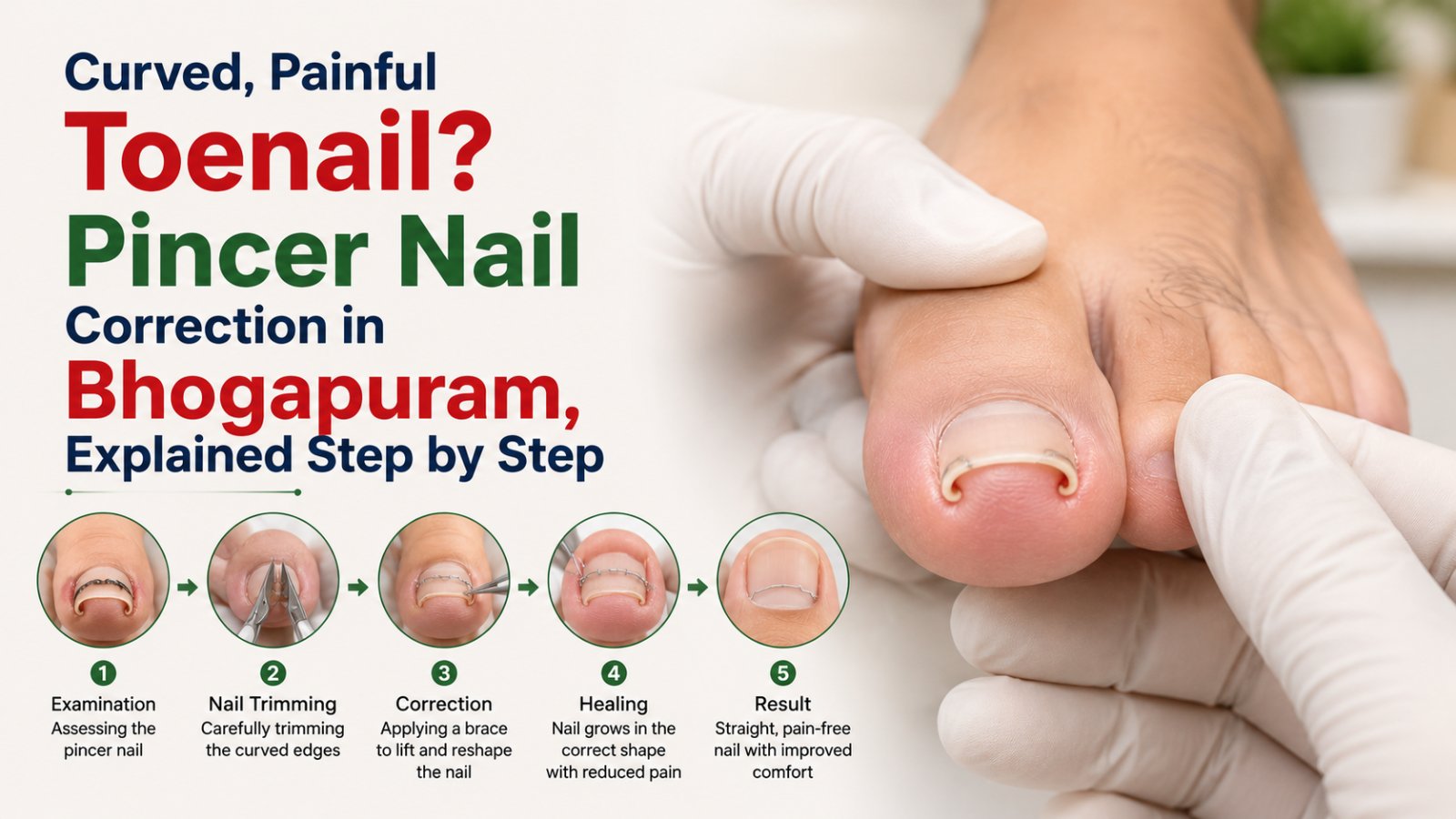
Pincer nail correction in Bhogapuram treats a toenail that curves inwards so sharply that its edges pinch the nail bed. Mild cases are corrected with a nail brace and better trimming. Severe or recurring cases need a small surgical procedure on the nail edge or its growth zone.
A pincer nail is not just an ugly toenail. The nail plate rolls in on itself like a tube and squeezes the soft tissue underneath, which is why it hurts far more than it looks like it should. The good news is that it is very treatable, and most people do not need surgery.
How do you know it is a pincer nail?
You likely have a pincer nail if the toenail curves in sharply from side to side, becoming narrower towards the tip, and the skin under the edges is tender or has thickened. It is sometimes called a trumpet nail because of that rolled shape.
Run through this quick check:
- Side-to-side curl that gets tighter towards the free end of the nail.
- Pain on light pressure on top of the nail, or when wearing closed shoes.
- Thickened, tender skin trapped along the nail edges.
- The big toe most often affected, though it can occur on any toe and often on both feet.
- Repeated ingrown episodes in the same nail.
- Discharge, redness or swelling if it has become infected.
It is easy to confuse with an ordinary ingrown nail. An ingrown nail digs its edge into the skin fold; a pincer nail curls along its whole width and squeezes the bed beneath it. The distinction matters because the treatments differ.
Why does a nail curl like that?
A pincer nail develops when something changes the shape of the nail bed or the growth plate, so the nail is produced in a curved form. Common triggers include an inherited tendency, a bony spur under the nail, arthritis of the toe joint, tight footwear, fungal infection and certain medicines.
- Hereditary tendency, often with the same nail shape in the family.
- Subungual exostosis, a small bony outgrowth beneath the nail pushing it upward and inward.
- Osteoarthritis or bony change in the toe joint.
- Tight, narrow or pointed shoes compressing the toe over years.
- Fungal nail infection thickening and distorting the plate.
- Some long term medicines, including certain beta blockers.
- Foot deformity that alters how the toe loads during walking.
Because a bony spur is a genuine possibility, an X-ray is sometimes taken. Bracing a nail that is being pushed up by bone will not hold, and the underlying cause needs treating instead.
Why does diabetes change the stakes?
In diabetes, a pincer nail is not just a painful nuisance. Nerve damage can hide the pain, poor circulation slows healing, and the pinched skin at the nail edge can break down into an ulcer that becomes an entry point for deep infection.
That is why circulation and sensation are checked before any nail procedure here. A nail operation on a foot with blocked arteries can create a wound that will not heal, so blood supply is assessed first and treated through our vascular services if needed. Related problems are listed under foot conditions we treat.
Which treatment is right for your nail?
Treatment is chosen by severity and by whether the nail keeps recurring. Mild curvature is managed with correct trimming and footwear, moderate curvature responds to a nail brace worn over months, and severe or repeatedly infected nails are treated surgically.
| Stage | Usual approach | What it involves |
|---|---|---|
| Mild curve, little pain | Conservative care | Straight-across trimming, roomier footwear, softening soaks, professional nail care |
| Moderate curve, recurring discomfort | Nail brace (orthonyxia) | A small brace bonded or hooked to the nail that gradually flattens it over months |
| Severe curve or repeated infection | Partial nail procedure | Removal of the offending nail edge, usually with treatment of that part of the growth zone |
| Bony spur beneath the nail | Treat the underlying bone | Removal of the exostosis so the nail can grow flat again |
| Fungal, thickened nail | Treat the infection first | Confirm with a nail sample, then antifungal treatment before reshaping |
How does a nail brace work?
A nail brace is a small metal or composite device fixed to the top of the nail that applies gentle, continuous outward tension. Over weeks to months the nail grows out flatter. It is painless, needs no cutting, and usually allows normal footwear straight away.
It suits people who want to avoid surgery, and it is often the first choice when the nail is only moderately curved. The trade-off is time and follow-up, since the brace needs periodic adjustment or replacement as the nail grows.
What happens in pincer nail surgery?
Pincer nail surgery is a small procedure done under local anaesthetic in the clinic. The curved edge of the nail is removed, and the matching part of the growth zone is usually treated so that section does not regrow curled. The toe is dressed and you walk out the same day.
- Assessment: nail examination, circulation and sensation check, X-ray if a bony spur is suspected.
- Local anaesthetic injected at the base of the toe.
- Removal of the offending nail edge, or the whole nail plate in severe cases.
- Matricectomy, treating that portion of the growth zone so the curl does not return.
- Correction of any bony spur underneath, where that is the cause.
- Dressing, with wound care guidance and, in diabetes, closer follow-up under non-surgical wound management.
What will happen at your appointment?
A first visit takes around twenty to thirty minutes. The nail is examined, both feet are checked, pulses and sensation are tested, and photographs are taken for comparison. You then discuss options, and most people leave with a plan rather than a procedure done the same day.
- Bring your diabetes reports and a list of current medicines.
- Wear the shoes you use daily, since footwear is often part of the cause.
- Do not trim or dig at the nail for a few days beforehand.
- Expect both feet to be examined, not just the painful toe.
What is aftercare like?
After a nail procedure, the toe is kept dry and dressed for the first few days, with a review at about a week. Most people return to normal footwear within one to two weeks. If a brace was fitted instead, there is no downtime, only periodic adjustment visits.
- Days 1 to 3: keep the dressing dry, elevate the foot when resting, mild painkillers if needed.
- Week 1: dressing change and wound review.
- Weeks 2 to 6: the treated edge heals over, normal shoes resume, activity returns to normal.
- Months 3 to 12: the nail grows out in its new shape, with periodic checks.
People with diabetes are reviewed more closely, because a small nail wound in a foot with reduced sensation deserves more supervision than it would in anyone else.
What should you never do at home?
Never cut down the sides of the nail, dig out the corners, or let anyone perform nail surgery outside a clinical setting. These are the most common routes to a diabetic foot infection, and they usually make the curl worse rather than better.
- Do not cut a V shape in the middle of the nail. It does not pull the edges in, despite the popular belief.
- Do not dig out the corners with blades, scissors or pins.
- Do not use chemical corn or nail removers on a diabetic foot.
- Do not have nails cut at a roadside or salon setting if you have diabetes.
- Do not ignore redness, discharge or swelling around the nail.
- Do trim straight across, not curved down at the edges, and file gently.
Regular professional nail care as part of preventive foot care prevents most of these problems entirely.
Will the pincer nail come back?
Recurrence is uncommon after a properly performed matricectomy, because the section of growth zone producing the curled nail has been treated. Braces correct the shape well but need to be worn long enough, and the curl can slowly return if the cause, such as tight footwear or a bony spur, is left unaddressed.
The underlying cause is what determines the long term outcome. Treat only the nail and the same nail comes back; treat the bone spur, the fungal infection or the footwear as well and it usually does not.
Pincer nail and diabetic nail care for Bhogapuram
Elegance Diabetic Foot & Ulcer Clinic (EDFC), led by Dr. Ashutosh Shah, provides nail correction, diabetic foot care, ulcer treatment and limb salvage from its centre in Surat, with care expanding into the Vizianagaram district including Bhogapuram. If you are looking for pincer nail correction in Bhogapuram, the first step is a nail and circulation assessment, so the right option is chosen rather than the quickest one.
You can send a clear photo of the toe to our team on WhatsApp for initial guidance and book a foot assessment. If the toe is red, swollen, discharging or you have fever, seek care the same day. Follow EDFC on Facebook, Instagram and YouTube for foot care guidance and real limb salvage stories.
A curled nail is fixable, and worth fixing early
Pincer nails rarely settle on their own, and each ingrown episode makes the skin around the nail tougher and more painful. Corrected early, most need nothing more than a brace and better shoes. Left for years, they become a surgical problem, and in a diabetic foot, an infection risk.
Next step: book a nail and foot assessment with Dr. Ashutosh Shah at Elegance Diabetic Foot & Ulcer Clinic, or send a photo of the toe on WhatsApp today to find out whether a brace or a procedure suits your nail.
Medical disclaimer: This article is for educational purposes only and is not a substitute for professional medical diagnosis or treatment. Nail procedures in people with diabetes require assessment of circulation and sensation first. Please consult Dr. Ashutosh Shah or a qualified specialist about your condition. For further guidance, see the NHS guide to ingrown toenails and the IWGDF diabetic foot guidelines.
quiz Frequently Asked Questions
This article is general education, not a diagnosis. If you have a diabetic foot wound, please have it assessed in person. Send a photo on WhatsApp or book a consultation.
About the Author

Dr. Ashutosh Shah, Plastic, Reconstructive & Diabetic Foot Surgeon, Elegance Diabetic Foot & Ulcer Clinic, Surat
Dr. Ashutosh Shah is a board certified plastic and reconstructive surgeon with over 22 years of experience and more than 10,000 limbs and feet saved. He founded Elegance Diabetic Foot & Ulcer Clinic, India's first chain of clinics dedicated to foot care, with centres in Surat and OPD partners across South Gujarat. He is known for a limb first approach, safe wound care and ethical, natural results.