Written by Dr. Ashutosh Shah, Plastic & Microvascular Surgeon - Diabetic Foot & Limb Salvage Specialist, Elegance Diabetic Foot & Ulcer Clinic (EDFC). Practising since 2004 (22+ years). Read full bio.
Medically reviewed by Dr. Ashutosh Shah · Published 6 August 2026 · Last reviewed 6 August 2026.
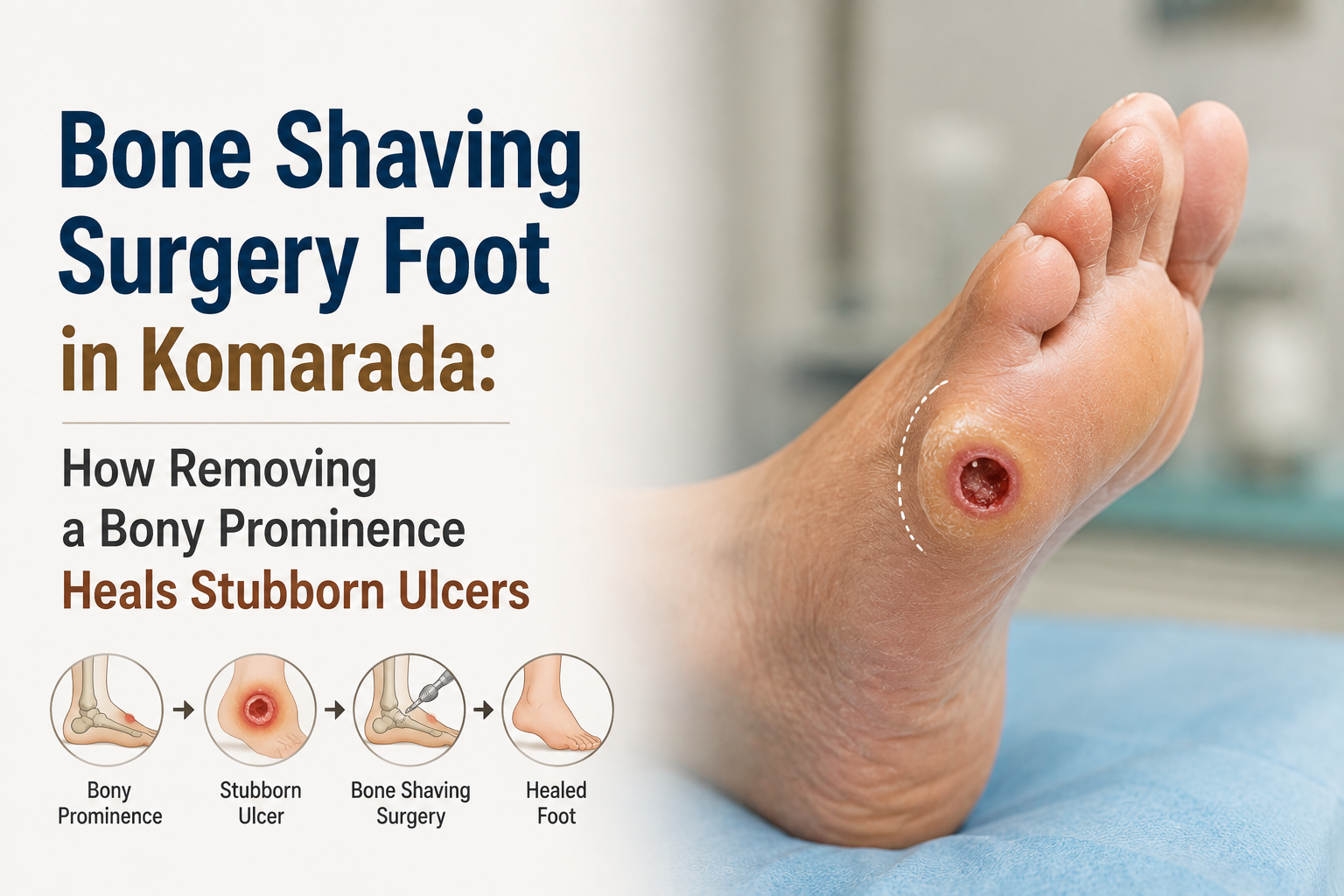
Bone shaving surgery foot in Komarada, known medically as exostectomy, removes a bony bump that presses against the skin from the inside. It is used mainly for diabetic foot ulcers that keep returning over a prominent bone, and for painful bony lumps that shoes cannot accommodate.
When an ulcer heals and reopens in the same spot again and again, the wound is rarely the real problem. Something underneath is pushing outward every time you take a step. Bone shaving removes that pressure at its source rather than treating the skin over and over.
What is bone shaving surgery of the foot?
Bone shaving surgery of the foot is an operation in which the surgeon trims down a bony prominence so it no longer presses against the overlying skin. The medical term is exostectomy, and it may also be called bony prominence resection or ostectomy.
Only the projecting part of the bone is removed. The aim is to flatten the pressure point while keeping the foot structurally sound and able to bear weight. It is one of the corrective options within diabetic foot surgery.
Why is bone shaving done for diabetic foot ulcers?
Bone shaving is done for diabetic foot ulcers because it removes the mechanical cause of the wound. In a foot with neuropathy, a bony bump concentrates pressure on a small patch of skin with every step, and no dressing or antibiotic can compensate for that.
This is called surgical offloading. Dressings treat the result, offloading treats the cause. When a wound has closed and reopened over the same bone three or four times, continuing with dressings alone is simply repeating a cycle that has already failed.
Who needs bone shaving surgery of the foot?
You may need bone shaving surgery if you have an ulcer that keeps returning over the same bony point, a Charcot foot with a rocker-bottom deformity, a painful bony lump that no footwear accommodates, or a prominence left after a previous foot operation.
- Recurrent ulcer over a bony prominence that heals and breaks down repeatedly.
- Charcot foot with rocker-bottom deformity, where collapsed bones bulge into the sole.
- Thick painful callus with a dark centre, which signals a wound forming underneath.
- Prominent metatarsal head or bone spur pressing into the skin.
- Bony prominence after previous surgery or amputation that has created a new pressure point.
- Bunion or bony lump that makes ordinary footwear impossible to wear safely.
Blood supply decides suitability. Circulation is checked before surgery is offered, and if the arteries are blocked they are treated first through our vascular services, because a bone cut cannot heal in a foot without blood flow.
Which foot problems are treated with bone shaving?
Bone shaving is used for several different bony prominences, and the site determines the approach and the recovery. The most common in diabetic practice is a prominence under the midfoot after Charcot collapse.
| Problem | Where the prominence is | Why surgery is considered |
|---|---|---|
| Charcot rocker-bottom foot | Under the midfoot, sole of the foot | Collapsed arch bulges downward and ulcerates repeatedly |
| Prominent metatarsal head | Ball of the foot | Recurrent plantar ulcer or deep callus under one bone |
| Bunion or bony lump | Side of the big toe joint | Pressure sore or ulcer from footwear rubbing |
| Heel spur or bony heel prominence | Back or underside of the heel | Non-healing heel ulcer or persistent pain |
| Post-surgical prominence | Edge of a previous amputation or operation site | New pressure point causing skin breakdown |
How is bone shaving surgery performed?
Bone shaving is performed under regional or general anaesthesia, usually as a short procedure. The surgeon reaches the bone through a small incision, trims the prominence with a burr or saw, smooths the surface, and closes the wound or manages the existing ulcer directly.
- Assessment: examination, X-rays to map the prominence, circulation and infection checks.
- Planning: deciding how much bone can be removed while keeping the foot stable.
- Anaesthesia: commonly an ankle or regional block.
- The incision: often placed away from the ulcer, or through it when the wound needs debriding anyway.
- Bone removal: the prominence is trimmed and the edges smoothed so no new sharp point remains.
- Wound management: debridement and dressings, sometimes negative pressure therapy under non-surgical wound management.
- Protected walking: a cast or post-operative shoe keeps load off the operated area.
Bone samples are often sent for culture, since a long-standing ulcer over bone may hide an underlying bone infection that needs targeted antibiotics.
How is bone shaving different from a metatarsal osteotomy?
Bone shaving removes part of a bone to flatten a prominence, while a metatarsal osteotomy cuts the bone and repositions it to redistribute pressure. Shaving is simpler and quicker to recover from; osteotomy allows more precise correction where the whole bone sits wrongly.
The choice depends on the deformity. A localised bump on an otherwise reasonable foot suits shaving. A metatarsal that is fundamentally too long or sitting too low is better corrected by repositioning it, as described in our post on metatarsal osteotomy.
What is recovery like after bone shaving surgery?
Recovery after bone shaving usually takes four to eight weeks, with protected weight bearing in a cast or special shoe for the first several weeks. An associated ulcer often starts closing within two to four weeks once the pressure underneath is gone.
- Week 1 to 2: elevation, wound checks, minimal walking in a post-operative shoe or cast.
- Week 2 to 6: protected weight bearing, dressing changes, sutures removed, wound review.
- Week 6 to 8: gradual return to normal walking as the wound and bone surface settle.
- After 2 months: custom insoles and offloading footwear to protect the result long term.
Healing is slower with poor blood sugar control, kidney disease or smoking. The weight-bearing instructions are the part patients most often shortcut, and it is the main reason a good operation gives a disappointing result.
What are the risks and complications?
The risks of bone shaving surgery include wound infection, delayed healing, instability if too much bone is removed, a new pressure point forming elsewhere, ulcer recurrence, and unrecognised bone infection needing further treatment.
- Wound infection, higher when operating on an already ulcerated foot.
- Delayed wound healing, particularly with poor circulation.
- Instability or collapse if the removed bone was structurally important.
- Transfer lesion, a new ulcer where pressure shifts to a neighbouring area.
- Underlying osteomyelitis discovered at surgery, needing prolonged antibiotics.
- Recurrence if offloading footwear is abandoned after healing.
These are weighed against the alternative. For a foot ulcerating repeatedly over the same bone, the untreated path leads to deep infection, bone involvement and eventually amputation.
Will the ulcer come back after bone shaving?
The chance of the same ulcer returning drops substantially once the prominence is removed, because the pressure causing it is gone. It is not a guarantee. Long term results depend on custom insoles, correct footwear, daily foot checks and blood sugar control.
In Charcot feet especially, the deformity is progressive, so new prominences can develop elsewhere over time. Regular review means a new pressure point is caught as a callus rather than as an ulcer.
What are the alternatives to bone shaving surgery?
Alternatives include total contact casting, removable offloading boots, custom moulded insoles, therapeutic footwear and regular callus removal. These are tried first, and surgery is considered when the ulcer keeps returning despite proper conservative treatment.
Non-surgical offloading works well for many people and is always the starting point. Surgery becomes the sensible option when good conservative care has had a fair trial and the skin is still breaking down. Ongoing preventive foot care is what keeps most patients out of theatre altogether.
When should you get a bony prominence checked?
Get it checked if a callus keeps rebuilding in the same place, if there is a dark spot or bleeding under a callus, if a bump has appeared and your foot shape is changing, or if an ulcer over a bony point has failed to heal after several weeks.
A hot, swollen, red foot in someone with diabetes and neuropathy, with or without a wound, needs prompt assessment in its own right, since this can be an early Charcot foot before deformity sets in. Related problems are listed under foot conditions we treat.
Diabetic foot surgery and ulcer care for Komarada
Elegance Diabetic Foot & Ulcer Clinic (EDFC), led by Dr. Ashutosh Shah, provides diabetic foot surgery, limb salvage and reconstruction from its centre in Surat, with diabetic foot care expanding across northern Andhra Pradesh, including Komarada. If you are considering bone shaving surgery foot in Komarada for an ulcer that keeps returning, the first step is a pressure, X-ray and circulation assessment rather than another dressing.
You can send a clear photo of the affected area to our team on WhatsApp for initial guidance and book a foot assessment. If the foot is hot, swollen, discharging or you have fever, go to hospital the same day instead. Follow EDFC on Facebook, Instagram and YouTube for foot care guidance and real limb salvage stories.
Remove the cause, not just the callus
A wound that keeps returning to the same spot is pointing at the bone beneath it. Shaving away that prominence is a small operation with a large effect, and it is far easier to do before the ulcer becomes deep or infected.
Next step: book a foot assessment with Dr. Ashutosh Shah at Elegance Diabetic Foot & Ulcer Clinic, or send a photo of your foot on WhatsApp today for initial guidance on whether bone shaving is likely to help.
Medical disclaimer: This article is for educational purposes only and is not a substitute for professional medical diagnosis or treatment. Suitability for bone shaving surgery depends on your circulation, infection status, bone quality and overall health. Please consult Dr. Ashutosh Shah or a qualified specialist about your condition. For further guidance, see the NHS guide to bunions and the IWGDF diabetic foot guidelines.
quiz Frequently Asked Questions
This article is general education, not a diagnosis. If you have a diabetic foot wound, please have it assessed in person. Send a photo on WhatsApp or book a consultation.
About the Author

Dr. Ashutosh Shah, Plastic, Reconstructive & Diabetic Foot Surgeon, Elegance Diabetic Foot & Ulcer Clinic, Surat
Dr. Ashutosh Shah is a board certified plastic and reconstructive surgeon with over 22 years of experience and more than 10,000 limbs and feet saved. He founded Elegance Diabetic Foot & Ulcer Clinic, India's first chain of clinics dedicated to foot care, with centres in Surat and OPD partners across South Gujarat. He is known for a limb first approach, safe wound care and ethical, natural results.