Written by Dr. Ashutosh Shah, Plastic & Microvascular Surgeon - Diabetic Foot & Limb Salvage Specialist, Elegance Diabetic Foot & Ulcer Clinic (EDFC). Practising since 2004 (22+ years). Read full bio.
Medically reviewed by Dr. Ashutosh Shah · Published 5 August 2026 · Last reviewed 5 August 2026.
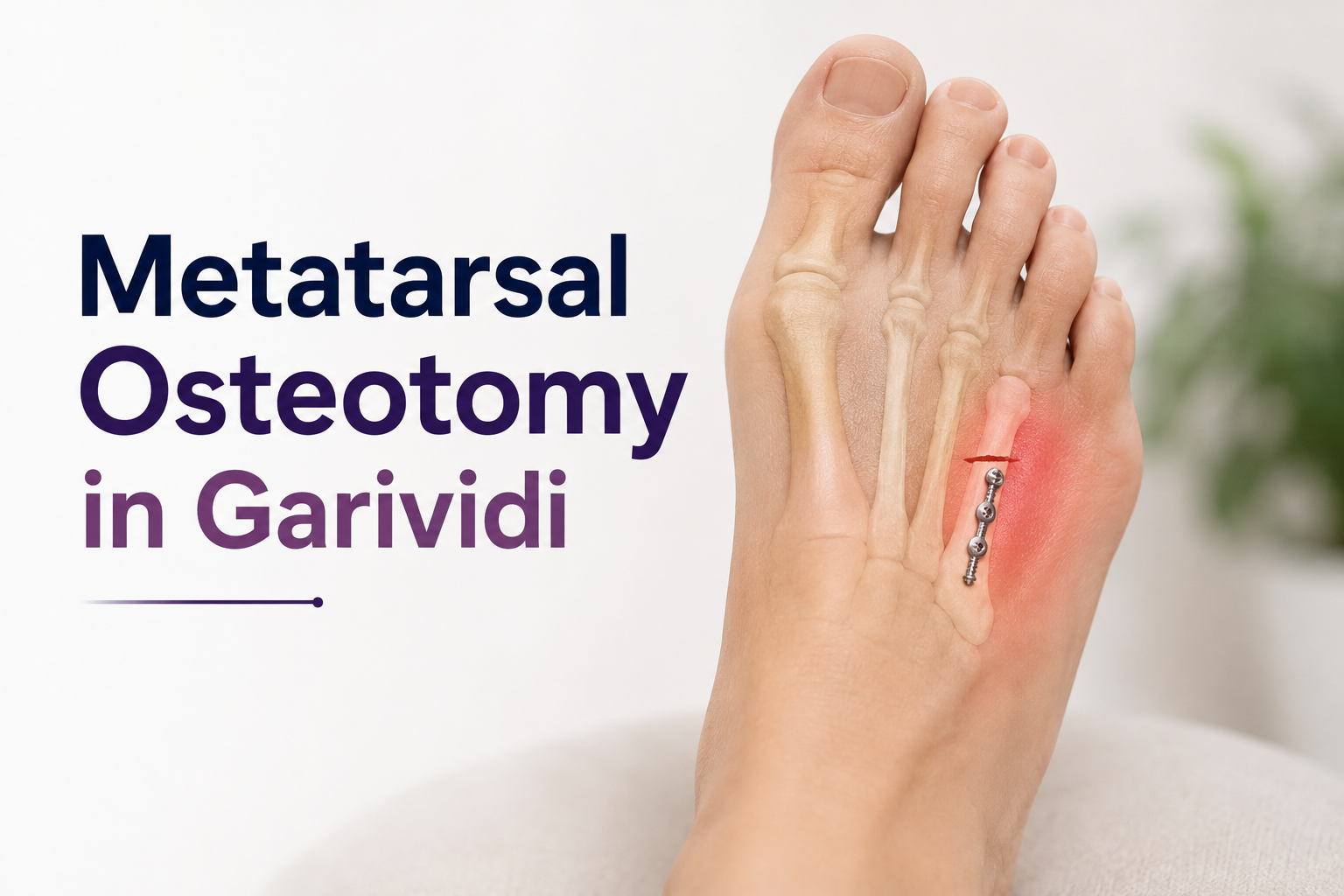
Metatarsal osteotomy in Garividi is a surgery that cuts and repositions a metatarsal bone in the forefoot to take pressure off a specific spot on the sole. It is used mainly for recurrent diabetic foot ulcers under the ball of the foot and for painful metatarsalgia that has not settled with footwear and offloading.
Some foot ulcers heal, then come back in exactly the same place within months. That pattern usually means the problem is not the wound, it is the bone pressing down on it. Metatarsal osteotomy fixes the pressure rather than dressing the result.
What is a metatarsal osteotomy?
A metatarsal osteotomy is an operation in which the surgeon makes a planned cut in one of the five long bones of the forefoot and shifts or shortens it so that weight is spread more evenly across the sole. The bone is then held in its new position while it heals.
The goal is mechanical, not cosmetic. A metatarsal head that sits lower than its neighbours concentrates pressure on a small patch of skin every single step. Reduce that peak pressure and the skin over it can finally heal and stay healed. It is one of the corrective options within diabetic foot surgery.
Why is metatarsal osteotomy done for diabetic foot ulcers?
Metatarsal osteotomy is done for diabetic foot ulcers because it removes the cause of the ulcer rather than treating the wound alone. In a neuropathic foot, high pressure under a metatarsal head breaks the skin down repeatedly, and dressings cannot fix a bone that is in the wrong place.
This approach is called surgical offloading. International diabetic foot guidance recognises it for ulcers under the metatarsal heads that have failed proper non-surgical offloading. In practice, patients often describe years of a wound closing and reopening before anyone examined the bone underneath.
Who needs a metatarsal osteotomy?
You may need a metatarsal osteotomy if you have a plantar ulcer that keeps returning in the same place, a deep callus under the ball of the foot, a clawed or dislocated toe pushing the metatarsal head down, or metatarsalgia that has not responded to insoles and footwear changes.
- Recurrent ulcer under a metatarsal head that heals and breaks down again.
- A non-healing plantar ulcer despite good wound care and total contact casting.
- Thick painful callus with bleeding or a dark spot underneath, which signals a wound forming.
- Claw toes or hammer toes that push the metatarsal head downwards.
- Metatarsalgia with pain in the ball of the foot that persists after conservative care.
- Deformity after a previous toe amputation that has shifted pressure onto a neighbouring bone.
Good blood supply matters. Before surgery is offered, circulation is checked, and if arteries are blocked they are treated first through our vascular services, because a bone cut cannot heal in a foot without blood flow.
What are the types of metatarsal osteotomy?
The main types of metatarsal osteotomy are distal osteotomies such as the Weil and chevron, basal osteotomies at the base of the bone, and percutaneous or floating osteotomies done through very small incisions. The choice depends on which bone is involved, how much correction is needed, and the state of the skin.
| Type | Where the cut is made | Typically used for |
|---|---|---|
| Weil osteotomy | Neck of the metatarsal, near the head | Shortening and lifting a prominent metatarsal head, claw toe correction |
| Chevron / distal osteotomy | Head end of the bone, V shaped cut | Smaller corrections, often for the first metatarsal and bunion deformity |
| Basal osteotomy | Base of the metatarsal | Larger corrections where more angular change is needed |
| Percutaneous / floating osteotomy | Small keyhole cut, bone left to settle without fixation | Offloading an active ulcer with minimal wound exposure |
In diabetic feet with an open ulcer, minimally invasive techniques are often preferred because they avoid a long incision in skin that is already compromised.
How is a metatarsal osteotomy performed?
A metatarsal osteotomy is performed under regional or general anaesthesia, usually as a short procedure. The surgeon exposes the bone through a small incision, makes a planned cut, repositions the bone to lift the pressure point, and fixes it with a small screw or wire where needed.
- Assessment: examination, pressure mapping, X-rays and circulation testing.
- Planning: deciding which metatarsal is overloaded and how much correction it needs.
- Anaesthesia: commonly an ankle or regional block.
- The osteotomy: the bone is cut and shifted, shortened or elevated.
- Fixation: a small screw or K-wire holds the position, or the bone is left to settle in keyhole techniques.
- Wound management: any existing ulcer is debrided and dressed, sometimes with negative pressure therapy under non-surgical wound management.
- Protected walking: a post-operative shoe or cast keeps load off the operated area.
What is recovery like after metatarsal osteotomy?
Recovery after metatarsal osteotomy usually takes six to twelve weeks for the bone to unite, with protected weight bearing in a special shoe or cast for the first several weeks. An associated ulcer often begins to close within weeks once the pressure is gone.
- Week 1 to 2: elevation, wound checks, minimal walking in a post-operative shoe.
- Week 2 to 6: protected weight bearing, dressing changes, sutures removed, X-ray review.
- Week 6 to 12: bone union confirmed on X-ray, gradual return to normal footwear.
- After 3 months: custom insoles and offloading footwear to protect the result long term.
Healing is slower in diabetes, especially with poor sugar control, kidney disease or smoking. Following the weight bearing instructions exactly is the part patients most often underestimate.
What are the risks and complications?
The risks of metatarsal osteotomy include infection, delayed or failed bone union, transfer lesions where a new pressure point develops under a neighbouring metatarsal, stiffness of the nearby toe joint, and recurrence of the ulcer if offloading footwear is not used afterwards.
- Wound infection, higher in an already ulcerated diabetic foot.
- Delayed union or non-union of the cut bone.
- Transfer ulcer under an adjacent metatarsal head.
- Toe stiffness, swelling or a floating toe that no longer touches the ground.
- Recurrence if custom footwear and follow-up are abandoned.
These risks are real but manageable, and they are weighed against the alternative, which for a repeatedly ulcerating foot is often infection, bone involvement and eventual amputation.
Does metatarsal osteotomy prevent ulcers from coming back?
Metatarsal osteotomy substantially reduces the chance of the same ulcer returning, because it corrects the pressure that caused it. It is not an absolute guarantee, and long term protection still depends on custom insoles, correct footwear, daily foot checks and blood sugar control.
Think of the surgery as removing the cause and the aftercare as keeping it removed. In our practice, patients who continue with proper offloading footwear do far better than those who return to ordinary chappals once the wound closes.
What are the alternatives to surgery?
Alternatives to metatarsal osteotomy include total contact casting, removable offloading boots, custom insoles and therapeutic footwear, regular callus removal, and tendon procedures for toe deformity. These are tried first, and surgery is considered when the ulcer keeps returning despite them.
Non-surgical offloading works well for many people and is always the starting point. The decision to operate is made when good conservative treatment has been given a fair trial and the foot is still breaking down. Regular preventive foot care is what keeps most patients out of the operating theatre.
Metatarsal osteotomy and foot ulcer surgery for Garividi
Elegance Diabetic Foot & Ulcer Clinic (EDFC), led by Dr. Ashutosh Shah, provides diabetic foot surgery, limb salvage and reconstruction from its centre in Surat, and is expanding diabetic foot care into the Vizianagaram district, including Garividi. If you are considering a metatarsal osteotomy in Garividi for an ulcer that keeps coming back, the first step is a proper pressure and circulation assessment, not another dressing.
You can send a clear photo of the sole of the foot to our team on WhatsApp for initial guidance and book a foot assessment. If the foot is swollen, hot, discharging or you have fever, go to hospital the same day instead. Follow EDFC on Facebook, Instagram and YouTube for foot care guidance and real limb salvage stories.
Stop treating the wound, fix the pressure
An ulcer that returns to the same spot is telling you something about the bone underneath it. If you have a recurring plantar ulcer, a deep callus under the ball of the foot, or pain that insoles have not solved, get the pressure assessed before the wound becomes an infection.
Next step: book a foot assessment with Dr. Ashutosh Shah at Elegance Diabetic Foot & Ulcer Clinic, or send a photo of your foot on WhatsApp today for initial guidance on whether surgical offloading is likely to help.
Medical disclaimer: This article is for educational purposes only and is not a substitute for professional medical diagnosis or treatment. Suitability for metatarsal osteotomy depends on your circulation, infection status, bone quality and overall health. Please consult Dr. Ashutosh Shah or a qualified specialist about your condition. For further guidance, see the NHS guide to metatarsalgia and the IWGDF diabetic foot guidelines.
This article is general education, not a diagnosis. If you have a recurring foot ulcer or callus under the ball of your foot, please have it assessed in person. Book a consultation or send a photo on WhatsApp.
quiz Frequently Asked Questions
This article is general education, not a diagnosis. If you have a diabetic foot wound, please have it assessed in person. Send a photo on WhatsApp or book a consultation.
About the Author

Dr. Ashutosh Shah, Plastic, Reconstructive & Diabetic Foot Surgeon, Elegance Diabetic Foot & Ulcer Clinic, Surat
Dr. Ashutosh Shah is a board certified plastic and reconstructive surgeon with over 22 years of experience and more than 10,000 limbs and feet saved. He founded Elegance Diabetic Foot & Ulcer Clinic, India's first chain of clinics dedicated to foot care, with centres in Surat and OPD partners across South Gujarat. He is known for a limb first approach, safe wound care and ethical, natural results.