Written by Dr. Ashutosh Shah, Plastic & Microvascular Surgeon - Diabetic Foot & Limb Salvage Specialist, Elegance Diabetic Foot & Ulcer Clinic (EDFC). Practising since 2004 (22+ years). Read full bio.
Medically reviewed by Dr. Ashutosh Shah · Published 5 August 2026 · Last reviewed 5 August 2026.
Fasciotomy surgery in Vizianagaram is an emergency operation that cuts open the tough tissue layer around a muscle compartment to release dangerous pressure inside the leg or foot. It is done for compartment syndrome and severe spreading infection. Delay of even a few hours can cause permanent muscle and nerve damage.
Fasciotomy is not a procedure anyone plans for. It is what stands between a swollen, painful leg and permanent loss of function, and its whole value lies in being done early. This guide explains when it is needed, what happens during and after it, and what recovery realistically involves.
What is fasciotomy surgery?
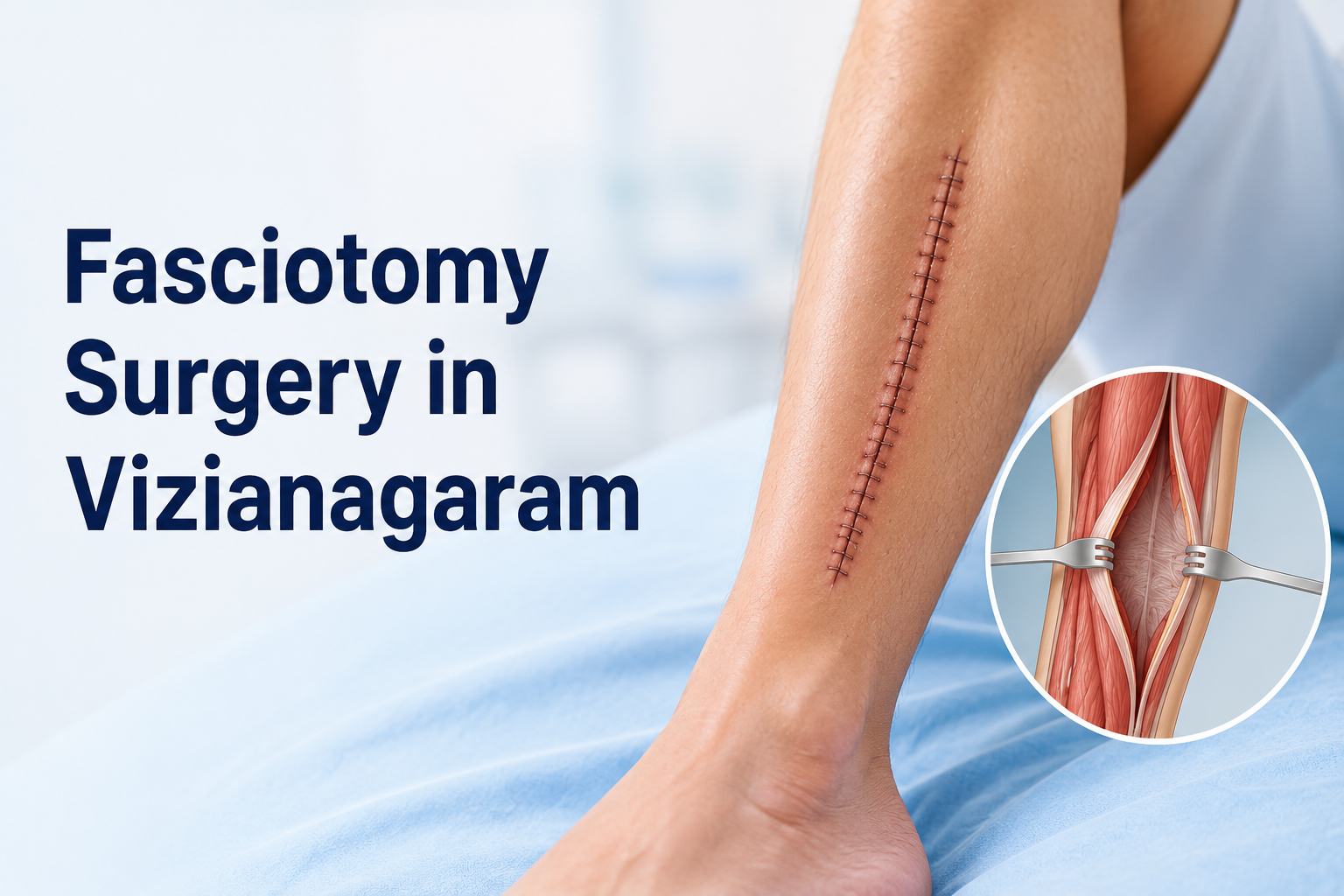
Fasciotomy surgery is an operation in which the surgeon cuts through the fascia, the tough sheet of tissue that encloses groups of muscles, to relieve pressure that has built up inside that compartment. The wound is deliberately left open at first so the swollen muscle has room to expand.
Muscles in the leg sit inside closed compartments that cannot stretch. When swelling raises the pressure inside one of them, the small blood vessels are squeezed shut and the muscle begins to die even though the main artery is still open. Cutting the fascia is the only way to reverse that.
When is fasciotomy surgery needed?
Fasciotomy surgery is needed when pressure inside a muscle compartment rises high enough to cut off blood supply, most commonly in acute compartment syndrome after injury, and in severe spreading infections of the leg or foot such as necrotizing fasciitis and deep diabetic foot infection.
- Acute compartment syndrome after a fracture, crush injury or severe soft tissue trauma.
- Severe spreading infection, including necrotizing fasciitis and deep abscess in the leg or foot.
- Deep diabetic foot infection tracking along the tendon sheaths and compartments of the foot.
- Reperfusion swelling after blood flow is restored to a limb that was blocked.
- Snake bite or severe burns causing rapid limb swelling.
- Prolonged limb compression, for example after being unconscious on a limb for hours.
In diabetic feet, the trigger is usually infection rather than injury. Pus under pressure in the deep spaces of the foot behaves exactly like compartment syndrome, and draining it early is what saves the toes.
What are the warning signs that a fasciotomy may be needed?
The warning signs are severe pain out of proportion to the injury, a tense swollen limb, pain that worsens sharply when the toes or foot are stretched, numbness or tingling, and later weakness or loss of pulses. Any of these need same day emergency assessment in hospital.
- Pain far worse than expected, not relieved by ordinary painkillers.
- Tight, hard, shiny swelling of the calf, foot or forearm.
- Severe pain on passive stretch of the toes or fingers.
- Pins and needles or numbness in the foot.
- Weakness or inability to move the toes.
- Cold, pale limb or absent pulse, which is a late and serious sign.
An important caution for people with diabetes: neuropathy blunts the pain that normally warns of rising pressure. In a numb foot, tense swelling, discharge, fever or feeling suddenly unwell may be the only signals, and they should be treated just as urgently.
Which compartments are released?
In the lower leg, four compartments may be released, and in the foot, several smaller ones. The surgeon decides which to open based on where the swelling and infection are, and often releases all compartments of a segment to be certain none is missed.
| Region | Compartments involved | Typical approach |
|---|---|---|
| Lower leg | Anterior, lateral, superficial posterior, deep posterior | Two incisions, one on each side of the leg |
| Foot | Medial, lateral, central, interosseous compartments | Dorsal incisions, sometimes with a medial incision |
| Thigh | Anterior, posterior, adductor | Lateral incision, extended if needed |
How is fasciotomy surgery performed?
Fasciotomy is performed under general or regional anaesthesia as an emergency. The surgeon makes long incisions over the affected compartments, opens the fascia along its full length, removes any dead tissue or pus, and leaves the wound open with a temporary dressing.
- Emergency assessment: clinical examination, blood tests, and pressure measurement where available.
- Anaesthesia and positioning in the operating theatre, usually within hours of diagnosis.
- Skin and fascia incision along the full length of each affected compartment.
- Inspection of the muscle to see what is alive, and removal of dead tissue where infection is present.
- Drainage and washout, with samples sent for culture in infected cases.
- Open dressing, often negative pressure therapy, covered under non-surgical wound management.
- Planned re-look in the theatre after 24 to 48 hours to check the muscle again.
The incisions look alarming to families, and it is worth understanding why they are left open. Closing them immediately would rebuild the very pressure the surgery was meant to relieve.
What happens after fasciotomy? How is the wound closed?
After a fasciotomy the wound is closed only once the swelling has settled and the tissue is clean, usually after several days. Closure is done either by gradually drawing the edges together, called delayed primary closure, or with a split skin graft when the gap is too wide.
Repeat visits to the theatre are normal, not a sign that something went wrong. Each one lets the surgeon confirm the muscle is recovering and remove any tissue that has since died. Reconstruction options are covered under diabetic foot surgery.
What is recovery like after fasciotomy surgery?
Recovery after fasciotomy usually takes several weeks to a few months. Wound closure or grafting happens within one to two weeks in most cases, and muscle strength and walking recover gradually with physiotherapy over the following weeks.
- Days 1 to 3: hospital care, limb elevation, repeat theatre checks, IV antibiotics if infection was the cause.
- Days 4 to 14: wound closure or split skin grafting once swelling settles.
- Weeks 2 to 6: graft healing, dressing changes, start of physiotherapy and gentle movement.
- Weeks 6 to 12: strengthening, gait retraining, gradual return to walking distance.
- Beyond 3 months: scar management, footwear adjustment and long term foot protection.
How much function returns depends heavily on how early the pressure was released. Muscle released within hours usually recovers well. Muscle that was starved of blood for a day or more may leave lasting weakness or stiffness.
What are the risks and complications of fasciotomy?
The risks of fasciotomy include infection of the open wound, bleeding, nerve injury, permanent muscle weakness or contracture if decompression was late, large scars, and the need for skin grafting. In diabetes, healing is slower and the infection risk is higher.
- Wound infection in a large open wound.
- Nerve or vessel injury during the incisions.
- Permanent weakness, stiffness or contracture from muscle that had already died.
- Extensive scarring and altered skin sensation.
- Need for skin grafting and further surgery.
These are weighed against what happens without surgery, which is muscle death, kidney injury from released muscle breakdown products, amputation and risk to life. In a confirmed compartment syndrome, not operating is the far greater risk.
How does fasciotomy relate to diabetic foot infection?
In severe diabetic foot infection, fasciotomy is used to open and drain the deep compartments of the foot where pus is trapped under pressure. Antibiotics alone cannot reach a closed, pus-filled space, so surgical release is what stops the infection spreading up the leg.
This is usually combined with removal of dead tissue, culture-guided antibiotics, blood sugar control and assessment of circulation through our vascular services. Done early, it frequently converts what looked like a major amputation into a foot that can be saved. Related conditions are listed under foot conditions we treat.
Can fasciotomy be avoided?
Fasciotomy can sometimes be avoided if the underlying problem is caught early, for example by treating a foot infection before it reaches the deep compartments, or by monitoring a swollen limb closely after injury. Once compartment pressure is genuinely raised, surgery cannot be avoided safely.
For people with diabetes, prevention is realistic and mostly unglamorous: daily foot checks, never walking barefoot, treating small wounds within days rather than months, controlling blood sugar and attending preventive foot care reviews.
Fasciotomy and limb salvage care for Vizianagaram
Elegance Diabetic Foot & Ulcer Clinic (EDFC), led by Dr. Ashutosh Shah, provides limb salvage, severe foot infection surgery and reconstruction from its centre in Surat, with diabetic foot care expanding into Vizianagaram. If you are searching for fasciotomy surgery in Vizianagaram because a limb is tense, painful or rapidly swelling, go to the nearest emergency department first, then contact our team for specialist opinion, wound reconstruction and follow-up care.
For non-emergency wounds, you can send a clear photo of the foot to our team on WhatsApp for guidance and book a foot assessment. Follow EDFC on Facebook, Instagram and YouTube for foot care guidance and real limb salvage stories.
Pressure released early is function saved
Everything about fasciotomy comes down to timing. A limb decompressed within hours usually walks again. A limb decompressed after a day often does not recover fully. If a leg or foot is tense, severely painful, numb or rapidly swelling, that is an emergency and not something to watch overnight.
Next step: for a swollen, painful or rapidly worsening limb, go to the nearest emergency department now. For a diabetic foot wound that is not healing, book an assessment with Dr. Ashutosh Shah at Elegance Diabetic Foot & Ulcer Clinic or send a photo on WhatsApp for initial guidance.
Medical disclaimer: This article is for educational purposes only and is not a substitute for professional medical diagnosis or treatment. Suspected compartment syndrome is a medical emergency requiring immediate hospital assessment. Please consult Dr. Ashutosh Shah or a qualified specialist about your condition. For further guidance, see the NHS guide to compartment syndrome and the IWGDF diabetic foot guidelines.
quiz Frequently Asked Questions
This article is general education, not a diagnosis. If you have a diabetic foot wound, please have it assessed in person. Send a photo on WhatsApp or book a consultation.
About the Author

Dr. Ashutosh Shah, Plastic, Reconstructive & Diabetic Foot Surgeon, Elegance Diabetic Foot & Ulcer Clinic, Surat
Dr. Ashutosh Shah is a board certified plastic and reconstructive surgeon with over 22 years of experience and more than 10,000 limbs and feet saved. He founded Elegance Diabetic Foot & Ulcer Clinic, India's first chain of clinics dedicated to foot care, with centres in Surat and OPD partners across South Gujarat. He is known for a limb first approach, safe wound care and ethical, natural results.