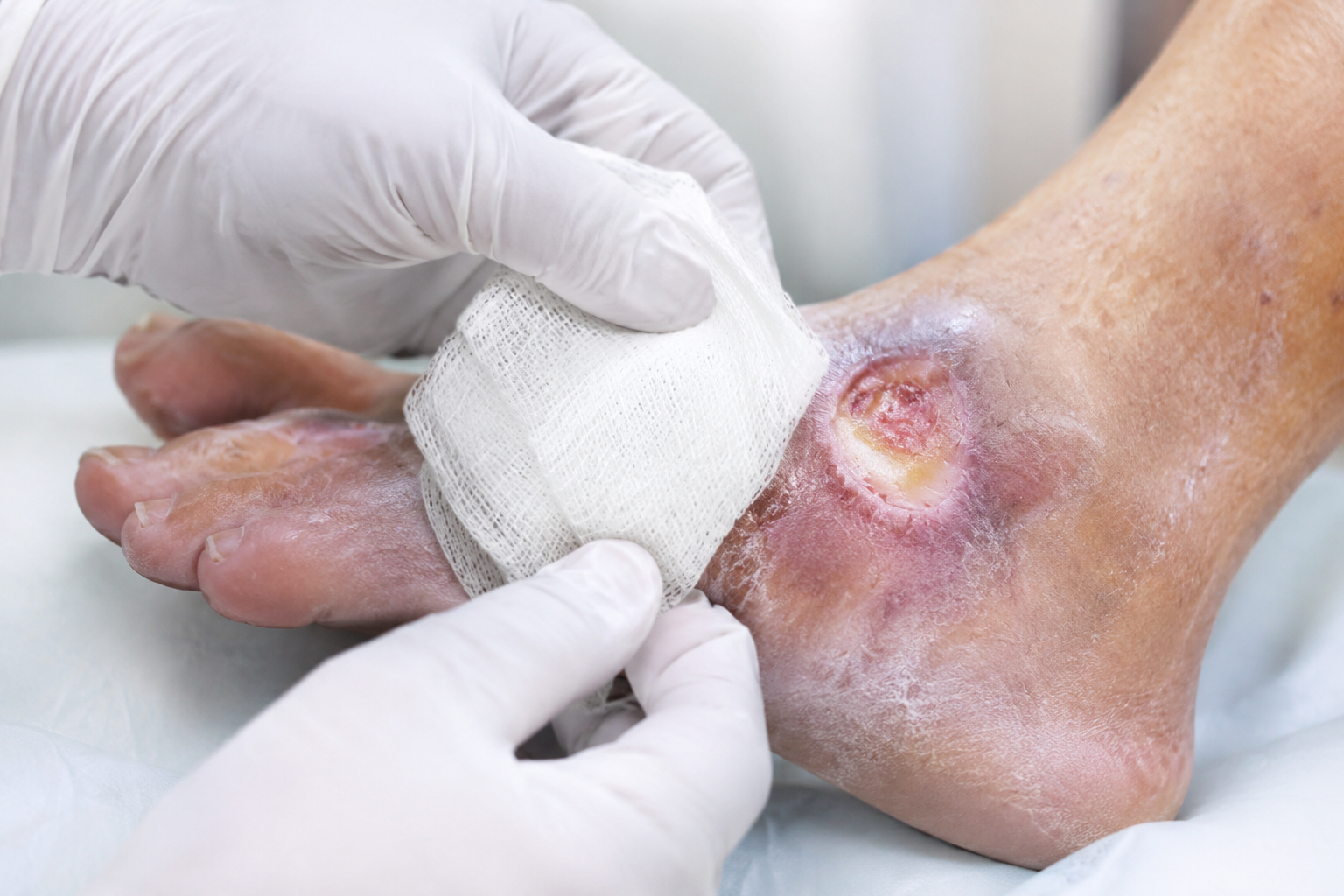

Collagen dressing benefits include faster healing of chronic and non-healing wounds, support for healthy new tissue growth, reduced inflammation, and a moist, protected wound environment. Made from natural collagen protein, these dressings are widely used for diabetic foot ulcers, pressure sores, and surgical wounds that are slow to heal.
If a wound has not healed in weeks or months, an ordinary gauze dressing is often not enough. This guide explains what a collagen dressing is, exactly how it helps a stalled wound start healing again, which wounds it suits, and when to see a specialist - with a focus on diabetic foot care.
What is a collagen dressing?
A collagen dressing is an advanced wound dressing made from purified collagen - the natural structural protein that holds skin and tissue together. It is placed directly on a wound to create a healing-friendly environment and to give the body a scaffold on which new tissue can grow.
Collagen is the most abundant protein in the human body and a key building block of skin. Because collagen drives the tissue-rebuilding stage of healing, supplying it directly to a stubborn wound can help kick-start repair that has stalled. Collagen dressings come as sheets, pads, gels, particles, or powder.
What are the main benefits of collagen dressing?
The main benefit of a collagen dressing is that it helps chronic, slow, or non-healing wounds start healing again by rebuilding a healthy wound environment. It works on the underlying reasons a wound is stuck, not just covering it.
- Speeds up healing of chronic and non-healing wounds that have stalled with regular dressings.
- Supports new tissue growth by attracting the repair cells (fibroblasts) that build granulation tissue.
- Provides a scaffold that new cells can migrate across to close the wound.
- Maintains a moist wound environment, which is proven to help wounds heal faster than drying out.
- Absorbs excess fluid (exudate) from a weeping wound while keeping the surface moist.
- Helps calm the wound by mopping up the enzymes that break down healthy tissue in chronic wounds.
- Is comfortable and non-adherent, so dressing changes are usually less painful.
How does collagen dressing help wounds heal?
Collagen dressings help wounds heal by fixing the biological "traffic jam" inside a chronic wound. Stalled wounds contain high levels of enzymes called matrix metalloproteinases (MMPs) that destroy the body's own new collagen as fast as it forms, so the wound never progresses.
A collagen dressing acts as a "sacrificial" layer: the excess enzymes attack the collagen in the dressing instead of the fragile new tissue in the wound. This protects the wound's own healing, lowers harmful inflammation, and lets granulation tissue finally build. At the same time, the collagen draws in repair cells and gives them a structure to grow on.
Which wounds can be treated with a collagen dressing?
Collagen dressings are used for a wide range of chronic and complex wounds, chosen case by case based on the wound's condition. They are especially valuable in diabetic foot care, where wounds are prone to stalling.
- Diabetic foot ulcers and other slow-healing foot wounds.
- Non-healing wounds present for several weeks or months.
- Pressure ulcers (bedsores) and venous leg ulcers.
- Surgical wounds that are healing slower than expected.
- Partial and full-thickness wounds, skin tears, and abrasions.
A collagen dressing is rarely used alone. At a specialist clinic it is combined with treating the cause of the wound - for example, offloading pressure on a diabetic foot, controlling infection, restoring blood flow, and improving blood sugar.
Is collagen dressing better than a normal dressing?
For a healthy, fresh wound, a simple dressing is fine. For a chronic or non-healing wound, a collagen dressing is usually more effective, because it actively rebuilds the healing environment instead of only covering the wound. The table below compares the two.
| Feature | Collagen dressing | Normal gauze dressing |
|---|---|---|
| Main role | Actively promotes healing & new tissue | Covers and protects the wound |
| Best for | Chronic, non-healing, diabetic wounds | Minor, clean, healthy wounds |
| Wound environment | Keeps moist, balanced, low-inflammation | Can dry out or stick to the wound |
| Dressing changes | Usually non-adherent, less painful | Can stick and disturb new tissue |
| Effect on stalled wounds | Helps re-start healing | Often leaves them stalled |
How is a collagen dressing applied and changed?
A collagen dressing is applied to a cleaned wound by a trained clinician and then covered with a secondary dressing to hold it in place. How often it is changed depends on how much fluid the wound produces and the specialist's plan - often every few days rather than daily.
Before applying it, the specialist cleans the wound and may remove dead tissue (debridement and wound management). The collagen is laid over the wound bed, and as it is absorbed it is replenished at each change. Modern clinics may combine it with other advanced options such as PRF dressings, antimicrobial (silver) dressings, and offloading, matching the dressing to the wound.
Are there risks, or times collagen dressing should not be used?
Collagen dressings are generally safe and well tolerated, but they are not right for every wound. They should not be the first choice on a dry, black (necrotic) wound, on third-degree burns, or on a wound with active, untreated infection, which needs treatment first.
Because most collagen dressings are sourced from animals (commonly bovine, porcine, or avian collagen), anyone with a known allergy to those sources should avoid them and tell their clinician. This is exactly why wound dressing choice should be made by a specialist after assessing the wound, not self-selected at a pharmacy.
When should you see a specialist for a non-healing wound?
See a wound-care specialist if any wound has not clearly improved within a few weeks, or sooner if you have diabetes. A wound that stays the same size, weeps, smells, or keeps reopening needs expert assessment and, often, an advanced dressing rather than ordinary gauze.
For people with diabetes, a non-healing foot wound is an urgent warning sign that can lead to infection or amputation if ignored. Early specialist care - including the right dressing - is the single biggest factor in saving the foot.
Advanced wound care at Elegance Diabetic Foot & Ulcer Clinic
At Elegance Diabetic Foot & Ulcer Clinic in Surat, led by Dr. Ashutosh Shah, non-healing and diabetic wounds are treated with advanced wound-care technology - including collagen dressings, PRF dressings, Acticoat (silver) dressings, and offloading solutions - matched to each wound. The principle is simple: every wound needs not just a dressing, but the right dressing, alongside treatment of the cause. If your wound has not healed in weeks or months, a specialist assessment is the safest next step.
Frequently Asked Questions
Do collagen dressings really speed up healing?
Yes. In chronic and non-healing wounds, collagen dressings help re-start stalled healing by supporting new tissue growth and protecting it from the enzymes that break it down. They work best when combined with treating the wound's cause, such as offloading pressure and controlling blood sugar in diabetic foot ulcers.
How often should a collagen dressing be changed?
It depends on how much fluid the wound produces and your specialist's plan, but collagen dressings are often changed every one to three days rather than daily. The collagen is gradually absorbed and replenished at each change. Always follow the schedule your wound-care clinician gives you.
Is a collagen dressing painful to use?
Collagen dressings are usually comfortable and non-adherent, meaning they do not stick hard to the wound. This makes dressing changes less painful than traditional gauze, which can pull at new tissue. Any strong or increasing pain should be reported to your specialist, as it can signal infection.
Can collagen dressing be used on an infected wound?
Not as a first step on an actively infected wound. The infection must be treated first, sometimes with an antimicrobial dressing such as silver. Once the infection is controlled, a collagen dressing can support healing. A specialist decides the right sequence after assessing the wound.
Is collagen dressing good for diabetic foot ulcers?
Yes, collagen dressings are widely used for diabetic foot ulcers because these wounds often stall and heal slowly. The dressing supports new tissue and a moist environment. It is combined with offloading, infection control, blood-flow care, and sugar control for the best chance of healing the foot.
What is a collagen dressing made from?
Most collagen dressings are made from purified animal collagen, commonly from cattle (bovine), pigs (porcine), or birds (avian), processed into sheets, gels, particles, or powder. If you have a known allergy to any of these sources, tell your clinician so an alternative dressing can be chosen.
Talk to a wound-care specialist
If your diabetic foot ulcer, surgical wound, or chronic wound is not healing at the expected speed, do not rely on ordinary dressings alone. Book a consultation with Elegance Diabetic Foot & Ulcer Clinic for an advanced wound-care assessment, or send a photo of your wound on WhatsApp for quick guidance on your next step.
This article is for general education only and is not a substitute for professional medical advice, diagnosis, or treatment. Wound dressing choice should be made by a qualified clinician. Please consult Dr. Ashutosh Shah or a qualified specialist about your individual wound.
quiz Frequently Asked Questions
This article is general education, not a diagnosis. If you have a diabetic foot wound, please have it assessed in person. Send a photo on WhatsApp or book a consultation.
About the Author

Dr. Ashutosh Shah, Plastic, Reconstructive & Diabetic Foot Surgeon, Elegance Diabetic Foot & Ulcer Clinic, Surat
Dr. Ashutosh Shah is a board certified plastic and reconstructive surgeon with over 22 years of experience and more than 10,000 limbs and feet saved. He founded Elegance Diabetic Foot & Ulcer Clinic, India's first chain of clinics dedicated to foot care, with centres in Surat and OPD partners across South Gujarat. He is known for a limb first approach, safe wound care and ethical, natural results.