Written by Dr. Ashutosh Shah, Plastic & Microvascular Surgeon - Diabetic Foot & Limb Salvage Specialist, Elegance Diabetic Foot & Ulcer Clinic (EDFC). Practising since 2004 (22+ years). Read full bio.
Medically reviewed by Dr. Ashutosh Shah · Published 6 August 2026 · Last reviewed 6 August 2026.
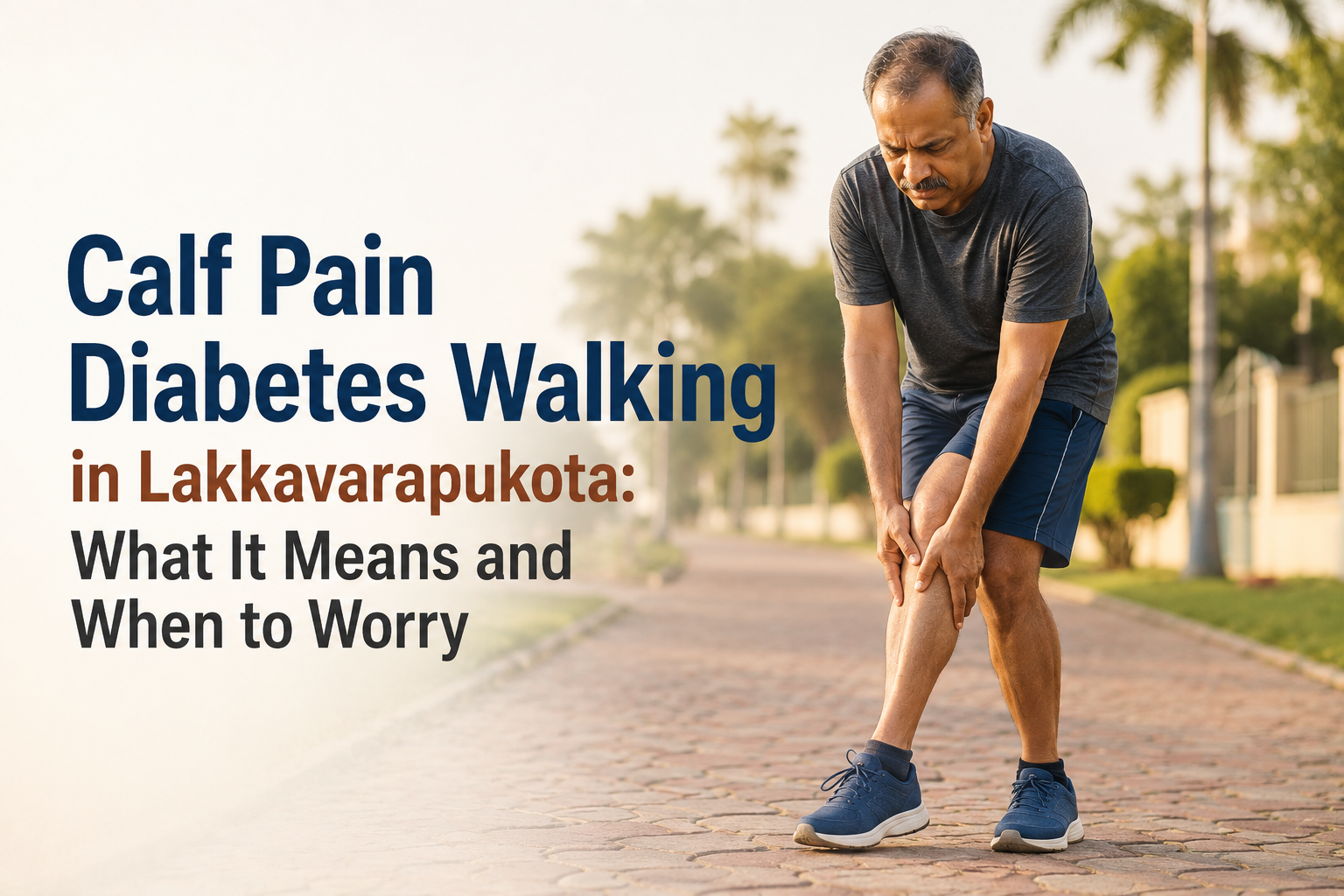
Calf pain diabetes walking in Lakkavarapukota is most often caused by narrowed leg arteries, a condition called intermittent claudication. The pain comes on after a predictable walking distance and eases within minutes of stopping. It is a warning sign of poor circulation and needs assessment, not painkillers alone.
Many people put this pain down to age, weakness or tiredness and simply walk less. That is the wrong response. The leg is telling you that the muscles are not getting enough blood, and in diabetes that same poor circulation is what later turns a small foot wound into an ulcer that will not heal.
What causes calf pain when walking if you have diabetes?
Calf pain when walking in diabetes is usually caused by peripheral artery disease, where the arteries supplying the leg become narrowed by plaque. During walking the muscles need more oxygen than the narrowed artery can deliver, so they cramp. At rest the demand drops and the pain settles.
The pattern is the clue. Pain that appears after roughly the same distance every time, forces you to stop, and disappears within a few minutes of standing still is classic. Pain that is present at rest, worse at night, or unrelated to activity usually has a different cause.
What is intermittent claudication?
Intermittent claudication is muscle pain, cramping or heaviness brought on by exercise and relieved by rest, caused by reduced arterial blood flow. In the leg it most often affects the calf, but it can also be felt in the thigh or buttock depending on which artery is narrowed.
It is the earliest and most treatable stage of peripheral artery disease. Left alone it can progress to rest pain, then to tissue loss, ulceration and gangrene. Catching it at the claudication stage is what keeps a foot out of trouble years later.
Why does diabetes cause blocked leg arteries?
Diabetes damages arteries because persistently high blood sugar injures the vessel lining, speeds up plaque build-up and stiffens the artery wall. In diabetes the disease tends to affect the smaller arteries below the knee, which are harder to treat and matter most for the foot.
- High blood sugar over years, damaging the inner lining of arteries.
- Smoking, which is the single strongest accelerator of leg artery disease.
- High blood pressure and high cholesterol, speeding plaque formation.
- Kidney disease, which is associated with heavily calcified vessels.
- Long diabetes duration and poor overall control.
- Inactivity, which reduces the small collateral vessels that bypass blockages.
Is calf pain while walking dangerous in diabetes?
Yes, it is a serious warning sign, though not usually an emergency by itself. Narrowed leg arteries mean arteries elsewhere are likely narrowed too, so the risk of heart attack and stroke is raised. It also predicts poor healing if a foot wound develops later.
In our practice, many patients with a non-healing ulcer say they had calf pain on walking for two or three years beforehand and never mentioned it to anyone. That window is exactly when treatment works best and costs the least.
What else can cause calf pain in diabetes?
Not all calf pain is arterial. Diabetic neuropathy, muscle cramps, deep vein thrombosis and spinal stenosis can all cause leg pain, and each has a different pattern. Telling them apart decides whether you need a scan, a specialist, or emergency care today.
| Cause | Typical pattern | What to do |
|---|---|---|
| Peripheral artery disease | Pain after a set walking distance, relieved within minutes of rest, cold foot, weak pulses | Specialist circulation assessment |
| Diabetic neuropathy | Burning, tingling or shooting pain, worse at night and at rest, often both feet | Medical review, not usually urgent |
| Muscle cramps | Sudden brief spasm, often at night, eases with stretching | Review hydration, salts and medicines |
| Deep vein thrombosis | One calf swollen, warm, tender and red, often without walking trigger | Same day hospital assessment |
| Spinal stenosis | Pain on standing and walking, relieved by sitting or bending forward, not by simply stopping | Spine assessment |
What are the red flag symptoms that need urgent care?
Seek urgent medical care if the leg becomes suddenly cold, pale and severely painful, if one calf swells and becomes tender, if you have pain in the foot at rest or at night, or if there is any wound, black area or foul discharge on the foot.
- Sudden severe pain with a cold, pale or blue leg - possible acute blockage, go to hospital immediately.
- One calf swollen, warm and tender - possible clot, needs same day assessment.
- Rest pain or night pain in the foot, relieved by hanging the leg down.
- A wound, ulcer or blackened toe that is not healing.
- Fever, spreading redness or foul discharge from the foot.
One caution specific to diabetes: neuropathy can mute the pain that would normally warn you. A numb foot with a cold, weak pulse can be in serious trouble while feeling almost normal.
How is the cause of calf pain diagnosed?
Diagnosis starts with examining the leg pulses and asking about the walking distance that triggers pain. Tests include the ankle brachial index, Doppler ultrasound, and where treatment is being planned, CT or catheter angiography to map exactly where the artery is narrowed.
- Pulse examination at the groin, behind the knee, ankle and foot.
- Ankle brachial index (ABI), comparing ankle and arm blood pressure.
- Doppler ultrasound to see flow and locate narrowing.
- Toe pressures, useful when ankle readings are unreliable.
- Angiography when angioplasty or bypass is being considered.
- Blood tests for sugar control, cholesterol and kidney function.
A technical point worth knowing: in long-standing diabetes the ankle arteries are often calcified and stiff, which can make the ABI read falsely normal or high. That is why a normal ABI alone should not reassure anyone with a cold foot or a non-healing wound, and toe pressure testing is added.
How is calf pain from poor circulation treated?
Treatment combines a supervised walking programme, medicines to protect the arteries, and control of blood sugar, blood pressure and cholesterol. If the blockage is severe or a foot wound will not heal, blood flow is restored with angioplasty or bypass surgery.
- Stop smoking. Nothing else you do will work as well if smoking continues.
- Structured walking programme: walk until the pain starts, rest, then walk again, most days.
- Medicines to reduce clotting risk and lower cholesterol, as prescribed by your physician.
- Tight control of blood sugar and blood pressure.
- Revascularisation by angioplasty, stenting or bypass through our vascular services, when needed.
- Foot protection with proper footwear and regular checks under preventive foot care.
- Wound treatment if an ulcer is already present, through non-surgical wound management or diabetic foot surgery.
Should you keep walking, or rest the leg?
Keep walking. Walking is treatment, not damage. Regular walking to the point of pain, then resting and continuing, encourages small bypass vessels to develop and usually increases the distance you can cover. Rest alone allows the leg to weaken and the pain-free distance to shrink.
The exception is when there is an open wound, an infected foot, or pain at rest. In those situations walking must be reduced and you need assessment first, because the priority shifts from exercise to protecting the tissue.
How can you stop it getting worse?
You can slow or stop progression by not smoking, walking regularly, controlling blood sugar, blood pressure and cholesterol, checking your feet daily and treating any wound early. These steps also lower the risk of heart attack and stroke.
- Never walk barefoot, and check both feet daily including between the toes.
- Wear correctly fitted footwear, and inspect shoes for stones or rough seams.
- Get any wound assessed within days, not months.
- Attend regular reviews that include pulse and sensation testing.
- Take prescribed medicines consistently, including cholesterol treatment.
When should you see a specialist?
See a specialist if calf pain on walking is limiting your daily distance, if the pain-free distance is shortening, if your feet are cold or numb, or if you have any wound that is not healing. Rest pain or a blackened toe needs urgent, not routine, review.
Diabetic leg circulation and foot care for Lakkavarapukota
Elegance Diabetic Foot & Ulcer Clinic (EDFC), led by Dr. Ashutosh Shah, provides circulation assessment, diabetic foot care, limb salvage and reconstruction from its centre in Surat, with care expanding into the Vizianagaram district including Lakkavarapukota. If you are dealing with calf pain diabetes walking in Lakkavarapukota, the useful first step is a pulse and circulation check, well before any wound appears.
You can send a clear photo of your feet to our team on WhatsApp for initial guidance and book a foot assessment. If a leg is suddenly cold and severely painful, or one calf is swollen and tender, go to hospital the same day instead. Follow EDFC on Facebook, Instagram and YouTube for foot care guidance and real limb salvage stories.
Treat the warning, not just the ache
Calf pain that stops you after a set distance is not simple weakness or age. It is a measurable circulation problem with proven treatment, and it is far easier to manage now than after a wound appears on a foot with poor blood supply.
Next step: book a circulation and foot assessment with Dr. Ashutosh Shah at Elegance Diabetic Foot & Ulcer Clinic, or send a photo of your feet on WhatsApp today for initial guidance.
Medical disclaimer: This article is for educational purposes only and is not a substitute for professional medical diagnosis or treatment. A sudden cold, pale, severely painful leg, or a swollen tender calf, needs immediate hospital assessment. Please consult Dr. Ashutosh Shah or a qualified specialist about your condition. For further guidance, see the NHS guide to peripheral arterial disease and the IWGDF diabetic foot guidelines.
This article is general education, not a diagnosis. If calf pain limits your walking, or your feet are cold, numb or have a wound, please have it assessed in person. Book a consultation or send a photo on WhatsApp.
quiz Frequently Asked Questions
This article is general education, not a diagnosis. If you have a diabetic foot wound, please have it assessed in person. Send a photo on WhatsApp or book a consultation.
About the Author

Dr. Ashutosh Shah, Plastic, Reconstructive & Diabetic Foot Surgeon, Elegance Diabetic Foot & Ulcer Clinic, Surat
Dr. Ashutosh Shah is a board certified plastic and reconstructive surgeon with over 22 years of experience and more than 10,000 limbs and feet saved. He founded Elegance Diabetic Foot & Ulcer Clinic, India's first chain of clinics dedicated to foot care, with centres in Surat and OPD partners across South Gujarat. He is known for a limb first approach, safe wound care and ethical, natural results.